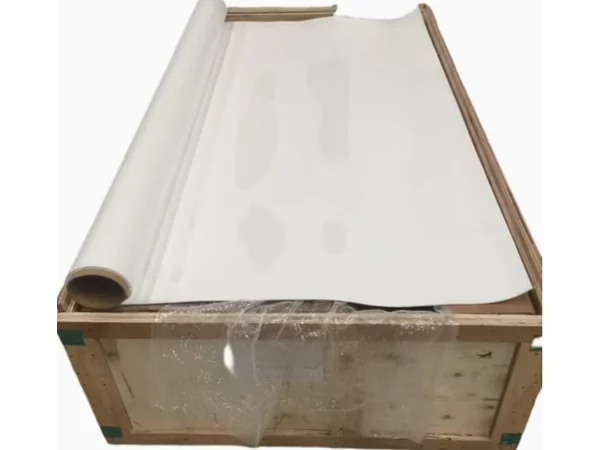
Expanded PTFE Sheet For Industrial Applications
Expanded PTFE sheet is a versatile sealing material designed for cutting into flange gaskets and other industrial sealing parts. It is produced by expanding PTFE into a network of interconnected fibrils. This structure provides superior flexibility and compressibility compared to traditional skived PTFE sheets, helping the finished gasket conform to minor irregularities on flange sealing surfaces.
Its broad chemical compatibility and reduced tendency toward creep and cold flow make expanded PTFE suitable for many industrial sealing applications, subject to the operating conditions and gasket design. For gasket manufacturers, expanded PTFE sheets offer a practical combination of material performance, processing flexibility, and availability in multiple thicknesses and dimensions.
| Test Properties | Standard Parameter | Test Result |
| Material | 100% Virgin PTFE | |
| Color | White | |
| Tensile strength(MPa) | ≧7Mpa | 17Mpa |
| Density(g/cm) | 0.75g/cm3 | |
| Max Working Temperature | Safe Temperature | 200℃ |
| Sealing Leakage | ≦1.0×10ˉ3 | 0.75×10ˉ3 |
| Compression Rate | ≦60% | 48% |
| Compression deformation rate | ≦40% | 38% |
| Resilient Rate | ≧6% | 12% |
| Volatility | ≦0.5% | Refer to FDA21CFR177.1210 |
| PH value | 0-14 | |
| Test Size: | 1500x1500x3mm |
TEST CONDITION REMARK:
1, Test Temperature: 20℃
2, Test Medium:99% Nitrogen
3, Test Medium Pressure:4.0Mpa
4, Compression rate and Resilient Test According to JB/T10688-2006 Regulation, Test Load is 17.25Mpa
5, Sealing Leakage Test According to JB/T10688-2006 Regulation, Preload Pressure is 17.25Mpa.
We have a complete set of production equipment to ensure quality control at every stage of the manufacturing process. We also have reliable sources of raw materials and strict inspection systems for them. Our monthly production capacity exceeds 1,000 sheets. For standard sizes, we maintain ample stock throughout the year and can deliver immediately. Additionally, we can print on the sheets as required.
| Item | Size(mm) | Thickness(mm) | Size(inch) | Thickness(inch) |
| 1 | 1500mmx1500,3000mm | 0.5 | 60” x 60” | 1/64” |
| 2 | 1500mmx1500,3000mm | 1 | 60” x 60” | 1/32” |
| 3 | 1500mmx1500,3000mm | 1.5 | 60” x 60” | 1/16” |
| 4 | 1500mmx1500,3000mm | 2 | 60” x 60” | 5/64” |
| 5 | 1500mmx1500,3000mm | 3 | 60” x 60” | 1/8” |
| 6 | 1500mmx1500,3000mm | 4 | 60” x 60” | 5/32” |
| 7 | 1500mmx1500,3000mm | 5 | 60” x 60” | 3/16” |
| 8 | 1500mmx1500,3000mm | 6 | 60” x 60” | 1/4” |
more sizes can be customized


Expanded PTFE Sheet FAQ


Expanded PTFE Sheet Manufacturing & Quality Control
As an expanded PTFE sheet manufacturer, Longseal manages the production process from PTFE resin preparation through sheet processing and final inspection.
Our in-house manufacturing capabilities allow us to maintain control over material consistency, sheet dimensions and production scheduling. With a monthly capacity exceeding 1,000 sheets, we support regular wholesale orders, customized specifications and the supply requirements of industrial gasket fabricators and distributors.
Quality checks are carried out at key manufacturing stages, focusing on material properties, dimensional accuracy, and the consistency of finished sheets.
We also provide sampling support and relevant technical documentation to help customers evaluate materials before bulk purchasing.
Expanded PTFE Sheet Supply for Different Customer Requirements
Longseal works with gasket manufacturers, sealing material distributors, and industrial customers who require expanded PTFE sheets for different purchasing and production purposes.
Gasket Manufacturers
Expanded PTFE sheets provide raw material for cutting ring gaskets, full-face gaskets, and special-shaped sealing components.
We supply uncut sheet material in various thicknesses and dimensions for customers using die cutting, CNC knife cutting, and other suitable fabrication methods.
Industrial Sealing Distributors
For sealing material distributors, reliable product specifications and replenishment arrangements are important for maintaining a practical inventory.
Longseal supports wholesale purchasing, repeat orders, and customized sheet printing to accommodate different distribution requirements.
OEM & Industrial Maintenance Supply
Equipment manufacturers and industrial maintenance suppliers may require ePTFE sheet materials for different equipment connections and replacement sealing components.
Our gasket sheets can be evaluated for use in chemical processing equipment, piping systems, tanks, and other industrial flange applications where their material properties are suitable.

Expanded PTFE Sheet Selection Guide for Gasket Manufacturers
Selecting expanded PTFE sheets for gasket manufacturing involves more than choosing a material thickness. Sheet dimensions, cutting efficiency, material consistency, and finished-gasket requirements can all affect production costs and sealing performance.
For gasket manufacturers and industrial sealing distributors, consider the following to identify suitable ePTFE sheet materials for production and purchasing.
1. Choosing Sheet Dimensions for Efficient Gasket Cutting
Expanded PTFE sheets are commonly purchased as raw material for manufacturing flange gaskets, ring gaskets, full-face gaskets, and other custom sealing components.
When selecting sheet dimensions, gasket manufacturers should consider the outside diameter, shape, and quantity of the finished gaskets, as well as the available cutting equipment.
For example, large-diameter gaskets may require wider sheet stock to avoid material joints, while smaller gaskets can often be arranged in multiple cutting patterns to improve material utilization.
The most economical sheet size is therefore not always the smallest or least expensive option. It is the format that provides a suitable balance between cutting yield, handling requirements, and material cost.
2. Selecting the Proper Expanded PTFE Sheet Thickness
Sheet thickness should be determined by the requirements of the finished gasket rather than by material availability alone.
Important considerations include:
Flange Surface Condition: The gasket must adjust to the relevant surface finish and minor irregularities without excessive deformation.
Available Gasket Stress: The selected material should achieve suitable compression under the available bolt load.
Operating Conditions: Temperature, pressure, chemical media, and operating cycles must be considered together.
Gasket Profile: The sealing width, inner and outer diameters, and available flange clearances can influence material selection.
A thicker sheet is not necessarily a better sealing solution. Excessive thickness may introduce additional deformation or relaxation concerns, depending on the joint design.
For critical applications, the final selection should be based on verified material data and the equipment manufacturer’s gasket requirements.
3. Evaluating Sheet Quality for Consistent Fabrication
For gasket manufacturers, material consistency affects both production efficiency and the performance of finished sealing components.
When evaluating expanded PTFE sheet stock, several characteristics need to be considered.
Thickness Uniformity
Consistent sheet thickness supports predictable gasket dimensions and helps maintain uniform compression across the sealing surface.
Material Structure and Density
The expanded structure and density influence how the material compresses and responds to sustained loading. These properties should be evaluated using relevant test data rather than visual appearance alone.
Surface and Edge Condition
Visible defects, contamination, and irregular sheet edges may affect cutting efficiency or usable material yield.
Cutting Performance
The material should be suitable for the intended fabrication process, whether using die cutting, CNC knife cutting, or other appropriate methods.
For regular industrial production, maintaining consistent material specifications between orders can reduce unnecessary processing adjustments.
4. Comparing Expanded PTFE Sheets with PTFE Sheets
Both expanded PTFE and skived PTFE sheets are manufactured from virgin PTFE materials, but their structures and processing characteristics differ.
The skived PTFE sheets are relatively dense and are used in applications requiring the properties of solid PTFE material.
Expanded PTFE sheets have a fibrillated structure that provides greater flexibility and compressibility. For flange gasket fabrication, these characteristics can improve conformity to the sealing surface and reduce the limitations associated with cold flow in conventional PTFE.
However, expanded PTFE is not automatically the preferred material for every application. Material selection should consider the required mechanical properties, sealing conditions, and the characteristics of the specific product grade.
For industrial gasket manufacturers, evaluating both material performance and fabrication requirements is essential when choosing between these sheet types.
5. Qualification Samples and Repeat Purchasing
Before establishing regular supply arrangements, gasket manufacturers may evaluate samples to confirm that the material meets their processing and application requirements.
A trial evaluation can include dimensional measurements, visual inspection, cutting trials, and review of relevant physical test data.
Once a material has been approved, keeping consistent purchasing specifications helps avoid unnecessary variation between production batches. Useful purchasing specifications include sheet dimensions, nominal thickness, applicable tolerances, material grade, packaging requirements, and any required inspection documentation.
Longseal supports material sampling, technical communication, and repeat purchasing arrangements for industrial customers seeking a stable source of expanded PTFE gasket sheets.